Policy Committee
Committee Chair: Stephen Venn
Committee Members: Laura Bosco, Noëlle Klein, Stefan Kreft, Nuria Selva, Vassiliki Kati, Zdenka Krenova, Per Sjögren-Gulve, Martin Dieterich, Peter Hobson, Pierre Ibisch, Francisco Moreira, Guy Pe'er, Volker Mauerhofer, Klaus-Peter Zulka, Geert de Snoo, Joette Croisier, Tomas Zuklin, Karine Princé.
Vision
To use sound scientific evidence to advance understanding for and action towards improved nature conservation in the European policy arena. This mission includes European conservation policies in global contexts.
Activities
The SCB Europe PC aims to strengthen the exchange with the public and decision makers without compromising the scientific rigor of an academic society. Maintenance of scientific rigor is not to be confused with retreat from public debate. Rather, outreach to the public and policy makers is needed to advocate for biological diversity and to implement scientific findings resulting from conservation biology research.
Activities of the Policy Committee range from our long-term initiatives to ad-hoc actions addressing urgent conservation issues. We work at various scales – from global dimensions down to local case studies. Our ‘tools’ are diverse and include:
Outreach to Peer Conservation Scientists and Practitioners
Among others, apart from elaborating scientific publications and presenting individual talks and posters, we organise policy-related symposia and workshops. SCB’s European and International Congresses for Conservation Biology (ECCBs and ICCBs, respectively) are our ‘natural’ platforms for this, but we also seek opportunities at other conferences.
Outreach to Decision-makers
We have used side-events at Conferences of Parties of UN conventions (CBD, UNFCCC etc.) as science-policy interfaces. Furthermore, we regularly meet representatives of the European Commission, Members of European Parliament, policy-makers and international NGOs in Brussels. Another important activity is the initiation and preparation of Statements on policy conservation issues for approval by the Board of Directors of the Europe Region.
Support for other SCB Activities
As Europe Policy Committee, naturally, we are sometimes asked for advice by the Europe Region Board of Directors, the Global Policy Committee (of which the Chair of the Europe Policy Committee is a member) or other units within SCB. Other examples for such support to the Society include fostering the eco-friendliness of ECCBs.
The work of the Policy Committee is based on the philosophy of taking advantage of members’ expertise by calling for and supporting their active involvement. The work of the Policy Committee is voluntary (i.e., non-paid).
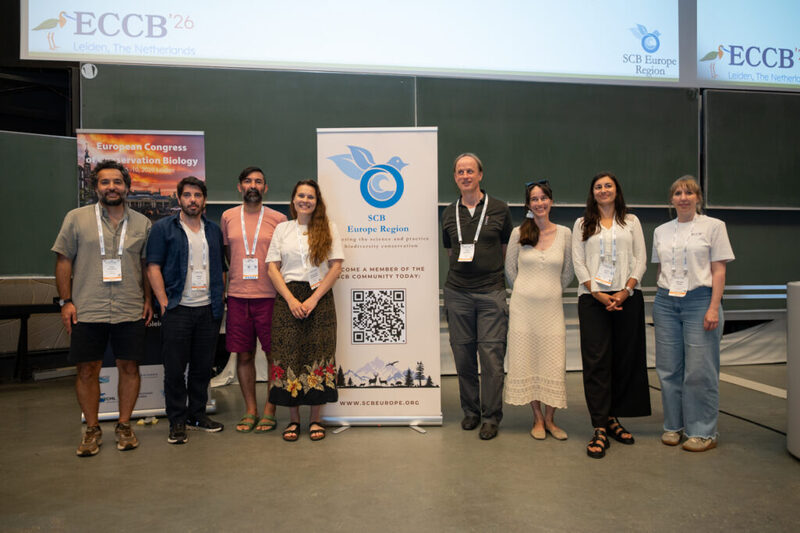
The Policy Committee usually meets online every three months and once per year in person to discuss policy issues and develop an operational plan for the following months. We also often use these opportunities to look at specific local conservation issues. Otherwise, our modus operandi is email, or ad-hoc meetings on occasion.
Long-term PC initiatives
The Europe Region Policy Committee is working on a number of long-term initiatives.
Roadless Areas Initiative
The Roadless Area Initiative was launched in 2006/2007 by the Policy Committee of the Europe Region of SCB. Inspired by the U.S. Roadless Conservation Rule, the main aim of this initiative is to highlight the importance of roadless areas for biodiversity conservation and the need to consider them more explicitly in the law. This Initiative has developed into a trans-sectional activity that, in addition to the Europe Region, to date includes the North America Region and the Latin America and Caribbean Region. Watch this
webinar by Vassiliki Kati: The biodiversity-windfarm-land take nexus: towards a roadlessness EU policy?
Natura 2000
The Habitats and Birds Directives are among the main linchpins on which nature conservation in the European Union rest. This EU legal framework, together with the Natura 2000 complex of protected areas that has been created, is another important focus of the work of our Policy Committee. For example, among a series of activities and products, we have published a paper resulting from a survey at the ECCB 2009 in Prague on the challenges for Natura 2000 management.
Common Agricultural Policy
The Common Agricultural Policy is a legal and funding framework of utmost importance for the fate of biological diversity in human-dominated landscapes of the EU.
In 2013 and 2014, the Policy Committee got involved in NGO consultations in the context of the final negotiations for the reform of the Common Agricultural Policy of the EU. We assumed the lead in expert surveys, among others, on existing data on high nature value grasslands. These efforts resulted in a Perspectives paper in the Science magazine in 2014.
Primary and old-growth forests
The conservation of the remaining primary and old-growth forests in Europe has been an important topic of our work for many years. Białowieża National Park in Poland, on the border with Belarus, the largest remnant of temperate primary forest in lowland Europe, and the old-growth forests in Šumava National Park, Czech Republic, have served us as case studies since 2003 and 2009, respectively. Both cases are success stories. In Białowieża, three SCB Letters to the Polish governments have contributed to an increase of strict protection of the forests in the region to more than 50 %. In Šumava National Park, four such Letters directed at the Czech government as well as the parliament have had a notable positive impact on otherwise detrimental changes of its management.
Diclofenac and vultures
Diclofenac, an anti-inflammatory drug used for humans and domestic animals, is notorious for being extremely harmful to raptor bird species, among other wildlife. The EU Commission decided to allow its use for domestic animals in the EU. In 2014, the EU Commission responded to a Letter by SCB-ES and assures to review the problematic permission for diclofenac for treatment of domestic animals.